The short version
- A traditional crew is strongest for real people, products, locations, and documentary authenticity.
- AI production is strongest for content volume, speed, testing, and cinematic concepts.
- A hybrid strategy often gives small businesses the best balance under $3,000 per month.
- The real bottleneck is usually the idea and feedback loop, not production quality alone. See why businesses lose leads without video for the full picture.
You're not buying video, you're buying outcomes
Attention, leads, trust, content volume, faster testing, and better communication are what the budget is really for. Businesses often compare AI and traditional production purely on visual polish, but polish is only one input into performance.
A beautiful video nobody sees or responds to is not a good investment regardless of how it was made. With a limited budget, the real questions are how much content you can produce, how quickly you can test ideas, and how much each production cycle costs in time and money.
What $3,000 buys from a traditional crew
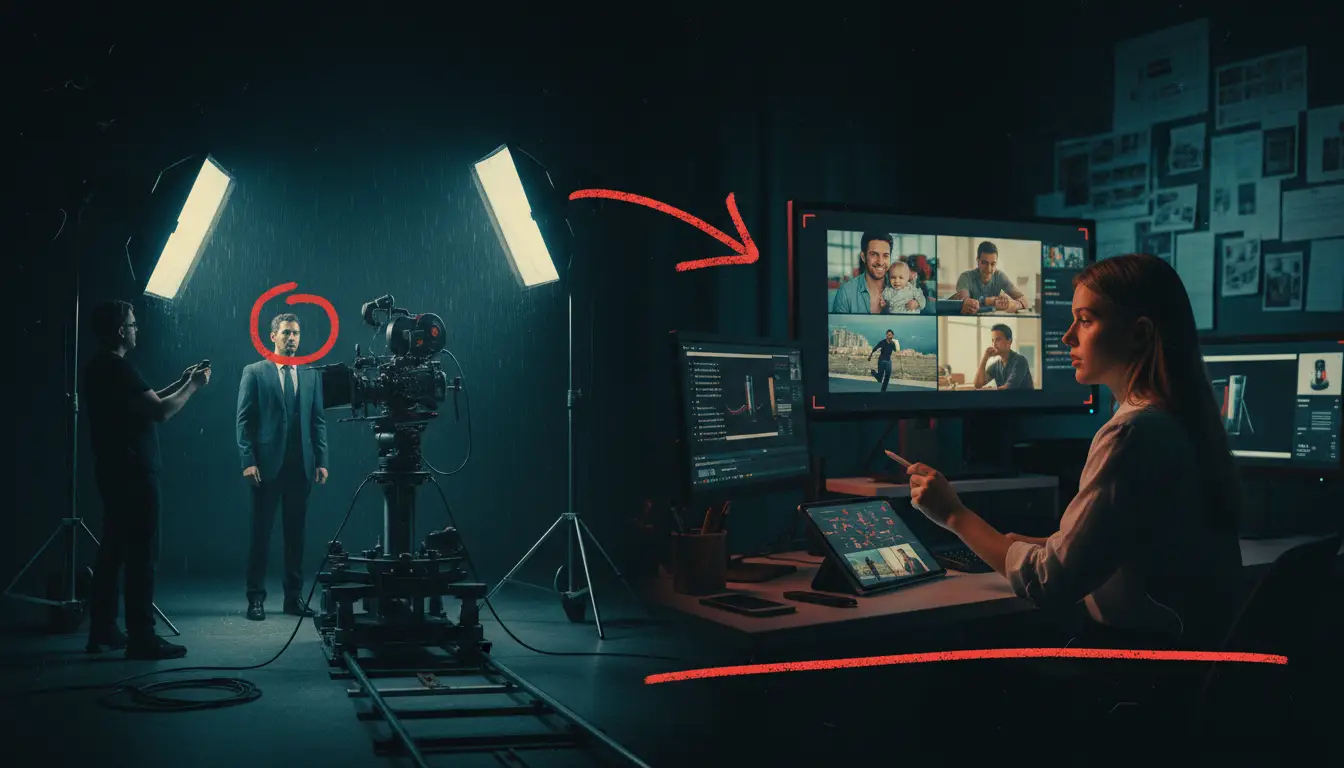
Under $3,000 a month, traditional production usually forces trade-offs. A shoot involves a videographer, camera and sound equipment, lighting, a location, talent, editing, and revisions. Even a modest version of that setup eats a large share of the budget quickly.
Most businesses end up with one production day, a handful of edited videos, and limited room to experiment. That can still be a solid investment. It answers a different need than a small business chasing a steady stream of marketing content, so it is worth being honest about which one you actually need.
For a grounded look at real pricing, see how much video marketing actually costs in 2026, backed by Clutch's 2026 agency pricing data.
What $3,000 buys with AI production
AI changes where the money goes. Instead of paying to physically build every environment and scene, more of the budget goes toward ideas, scripts, creative direction, and producing and testing variations. Entry-level tools like Runway (~$12/mo) and HeyGen (~$29/mo) make the software itself cheap — but the cost that matters is the strategy, scripting, and creative direction around it.
The result is not simply a cheaper version of traditional production. It is a different production model, and the main thing you are buying is creative volume: more concepts tested for the same spend. For a detailed breakdown of where AI wins and where it falls short, see how AI video fixes the volume problem without faking trust.
One big bet or several smaller ones
Put most of a $3,000 budget into one shoot day with a traditional crew, and you have made a fairly large bet on a small number of creative ideas. Put the same $3,000 into AI production, and you can usually generate several concepts and variations instead: different hooks, pain points, angles, and calls to action.
Marketing outcomes are uncertain. The audience decides what earns attention, not the marketer. AI does not remove that risk. It makes it cheaper to run more than one experiment against it.
AI vs. crew, side by side
| Factor | AI video production | Traditional production crew |
|---|---|---|
| Budget efficiency | High | Lower for small budgets |
| Content volume | High | Limited |
| Production speed | Fast | Slower |
| Creative experimentation | High | Often limited by production cost |
| Real people | Possible, depending on the concept | Excellent |
| Real products and locations | Possible, often best as hybrid | Excellent |
| Cinematic concepts | Highly accessible | Can be expensive |
| Authentic founder content | Limited without real footage | Excellent |
| Scalability | High | Limited by production resources |
| Best for frequent content | Strong | Can become expensive |
Neither wins across the board. The right choice depends on what role video is actually playing in your marketing.
When a real crew is hard to replace
If your founder or team is the product, personal trust matters. This includes consultants, coaches, lawyers, doctors, real estate agents, and financial advisors. Customers often want to see and hear the actual person they will work with.
If your product has physical detail that matters, such as jewelry, food, cars, furniture, or manufacturing equipment, customers usually need to see the real thing. AI visuals work best as supporting scenes rather than a substitute for the product itself.
Traditional production also wins when what you sell depends on documentary-style authenticity: behind-the-scenes footage, testimonials, live events, and factory processes. This is especially true for HVAC & plumbing and roofing, where seeing the real work builds instant credibility.
When AI is the stronger call
AI earns its keep when the real constraint is not authenticity but scale. If you need weekly social videos or multiple ad creatives, AI raises output without requiring a full shoot every time.
If your job is testing advertising, physically shooting every variation gets expensive fast. AI makes it cheaper to try different openings, offers, and emotional angles. And when your best idea is genuinely hard to film, AI makes ambitious cinematic concepts accessible without a blockbuster budget.

The strongest strategy under $3,000 is usually hybrid
The choice does not have to be all-or-nothing. Film the founder, product, team, real location, and customer testimonials, then combine that footage with AI-generated commercial scenes, visual metaphors, and additional creative variations.
That combination balances authenticity against scale. Under a tight budget, it is usually more efficient than trying to physically shoot every piece of content or replacing every real interaction with generated visuals.

The real bottleneck usually is not production quality
Most businesses do not have a production problem. They have an idea problem. You can hire the best crew in the city, shoot in 4K with expensive glass, and still fail because the customer does not care.
A video needs a reason to exist. It has to connect to a real problem, desire, fear, or curiosity gap before production quality matters. Production supports the message. It has never been the message.
How to actually allocate $3,000 a month
Do not put it all into one production day. Split it more like a marketer would:
20% / Strategy
Identify pain points, objections, and content angles. A weak idea does not improve just because it was filmed beautifully.
30% / Core content
Create primary service explanations, product content, and founder messaging.
30% / Testing
Try different hooks, headlines, and story structures. This is where AI production tends to pay off most.
20% / Optimization
Improve the opening, message, and pacing based on what previous testing showed.
The point is not random production. It is building a feedback loop.
Why volume matters more than most businesses assume
Every video you publish teaches you something: what customers care about, what language lands, and what objections keep surfacing. One expensive video every few months gives you a slow trickle of information. Testing several ideas a month gives you a faster one.
That is the actual shift AI brings to small business marketing: the cost of experimenting keeps dropping — and it's exactly why 82% of businesses that stuck with video report positive ROI.
Do not pick AI just because it is cheap
Cheap content can still hurt a brand. Generated video that feels generic, artificial, or disconnected from the real business can do more damage than no video at all.
The goal is not to fill a feed with AI content for its own sake. It is to produce marketing that communicates clearly and earns attention. That still requires strategy, creative direction, and real judgment before anything ships.
So what should you actually do?
Choose a crew if your top priority is authenticity: real people, real locations, real products, founder-led content, or testimonials.
Choose AI if your top priority is volume: more creatives, faster iteration, more testing, and cinematic concepts you could not otherwise afford.
Choose a hybrid if you need both real-world trust and high-volume output. Film reality where it matters and use AI where imagination and scale matter more.
With a tight budget, spending everything on a handful of expensive videos limits how much you can learn. Replacing every real interaction with generated visuals can quietly erode trust. The smarter move is understanding where each method earns its place — and pricing it out honestly.
